


The Next Founder helps founders build great startups. We offer advice on managing your mental health and productivity, hiring and managing great people, building a strong culture, and keeping people aligned and working on the right things. See the series overview at Welcome to The Next Founderand find out more about me at My Story.
“There is surely nothing quite so useless as doing with great efficiency what should not be done at all.”
— Peter Drucker
“There are no right answers to wrong questions.”
— Ursula K. Le Guin
“Your scientists were so preoccupied with whether or not they could that they didn’t stop to think if they should.”
— Michael Crichton, Jurassic Park
Less than the sum of the parts
When you signed on as a newly minted venture capitalist at a not-quite-top-tier fund, you knew the first deal you would do: you’d fund a dream team you worked with at your last job at BigCo: Sophie and Sergei.
Sophie is the technical co-founder. She’s built industrial-grade software for a decade and has a team of engineers eager to follow her to her next gig. Sergei ran the best sales team at BigCo, which blew out its quota year after year. A top technical founder paired with a top go-to-market founder? That’s the easiest decision in venture capital. You jumped at the chance to offer them $3 million in seed funding to leave BigCo behind.
It’s three months later, and today’s board meeting served up a healthy dollop of buyer’s remorse.
Sergei has pitched hundreds of prospects, but only a handful have agreed to kick the tires. Sophie and her team of three engineers are cranking out dozens of beautifully designed features, but customers won’t even log in.
They propose dumping money into Reddit ads and stuffing the product with more features. You’ve seen this plan before: “we promise to try harder.” You schedule weekly check-ins, hoping to nurse the team back to health.
You thought you’d make the Midas List by supporting great builders and great sellers, but now you’re wondering if there is a secret to this VC thing that remains elusive.
All dressed up and nowhere to go
Sophie and Sergei’s story is common. It’s happened to me and to many founders I know.
These founders don’t fail because they don’t know how to build or sell. They fail because they build and sell the wrong thing1. They haven’t learned how to be “product pickers.”
I first heard “product picker” as an Entrepreneur in Residence at Benchmark Capital. When Andy Rachleff and the other partners would debrief after a pitch, they’d ask, “Does this team have a product picker?”
Product picking is choosing the right problem to solve for the right customer at the right time. It’s picking the minimal feature set that will separate customers from their money. Pickers know how to differentiate from competitors. They pick markets big enough for a scalable startup. Once they pick their way to Product-Market Fit2, they keep picking product enhancements that stay ahead of the competition and win their markets.
Startups need to be great at three things: picking, building, and selling. Many founders know how to build and sell. Few know how to pick.
Theory versus reality
It’s not exactly breakthrough thinking that founders have to pick the right product to work on.
Stories like Sophie’s and Sergei’s motivated Steve Blank’s books and his Lean Launchpad program at Stanford, where I am a mentor3. The best startup resources, like The Lean Startup, The Mom Test, and Y Combinator Startup School, focus on product picking.
But even with so much free advice, why do so many founders fail because they plow ahead and build a product that is met with apathy? Why is my inbox full of updates that say, “Everything is going great! New hire, great office, features shipped on time. Now we just need customers...”
There is always a gap between knowing what to do and doing it — otherwise we’d all have six-pack abs. I’ve started several startups and invested in and advised many more. I haven’t seen a recipe that guarantees successful product picking, but I’ve seen a few patterns that derail founders:
1 - They don’t know what product picking is
Few people have seen product picking up close unless they were among the first few employees at a startup. They weren’t in the room where it happened.
Most of us are like Sophie and Sergei: we work on products someone picked long ago. Our day-to-day experience is with the tiny percentage of products that broke through and not the vast graveyard that didn’t. We don’t have a mental model for how difficult and rare successful product picking is.
Established companies have engineers, product managers, marketers, and sales reps, but no one has “product picker” on their business card. Product pickers answer a few crucial questions:
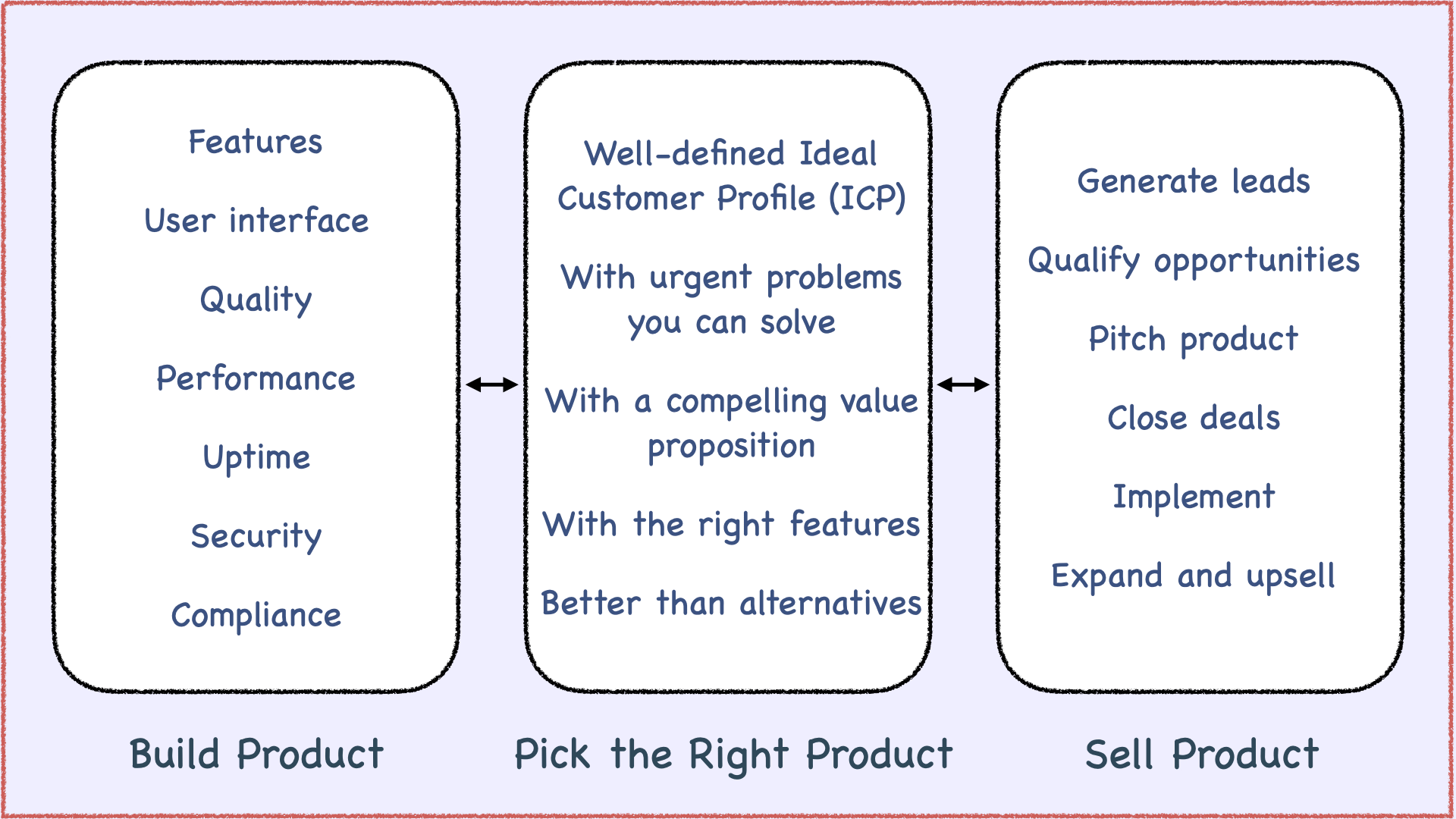
When I work with early-stage founders, we work through the answers to:
Customer - who is your Ideal Customer Profile (ICP)? What industry, size, geography, tech stack, and culture? How many of those customers have you spoken to? (Hopefully dozens)
Problem - what is the urgent problem you solve that they’ll pay for? What is the value proposition of your solution? How will you help the customer make money or save money? Show your math.
Features - what is the minimum feature set you could build to achieve that value proposition?
Positioning - what are those customers comparing you t4? Other vendors? Building their own solutions? Doing nothing?
Messaging - what language is working best to grab customers and get them interested?
Learning - what have you learned in the last 30 days that changed your plans? What *could* you learn that would cause you to pivot?
Market maturity - if your market is early, is there a critical mass of early adopter customers to sustain you until the market grows?
Market size - can your market become large enough to support the scalable startup you hope to build?
Focus - what good ideas have you said “no” to so that you can focus on even better ideas?
Few startups can answer these questions at first, which you’d expect since the point of an early-stage startup is to discover the answers, not assume you already know them. But answer them you must, and customer behavior, not just your opinions, has to support the answers.
2 - They aren’t paranoid enough
Some founders know product picking is hard, but they assume it’s hard for *other* founders, not for them. They just *know* their idea is awesome since, after all, it’s theirs.
That overconfidence isn’t a surprise. Most startups fail, so founders need an almost delusional level of confidence to believe they will be in the tiny minority of founders who build something big.
But effective founders combine confidence and humility. Confident their idea can lead to a big outcome but humble enough to know the work is discovering the specific path to get there. Confident their team can win the market but humble enough to know they have to find a market worth winning.
Ironically, the founder with the original idea for their startup can be the barrier to product picking. Their identity is tied to being “the idea person.” They may have argued for a larger equity grant because “I had the idea.” (Eye roll.) They want to be “visionary” and reject feedback that challenges the notion that they are Steve Jobs reincarnated.
3 - The founders don’t work together
Most founding teams have a single founder who owns product decisions, but the whole team has to work together to have a chance of picking the right ones. They shouldn’t do what Sophie and Sergei are doing, where one founder is out selling, and the other is sitting in the office writing code, but they aren’t working together to pick the right product.
That split can cause the co-founder conflict that kills so many startups. The business co-founder is angry that the technical co-founder hasn’t built a compelling product, and the technical co-founder is angry that the business co-founder isn’t closing deals.
The whole founding team should sit in customer meetings to get firsthand feedback about what problems they’ll pay to solve. They should constantly debate what they’ve learned and what adjustments are needed. Everyone should obsess about making the first customers successful and expanding their use.
Sophie and Sergei *might* be good product pickers, but they won’t find out until they devote time, run experiments, have healthy debates, and make hard decisions about where to focus.
4 - They don’t vibe with customers
Most early-stage startup advice amounts to the same thing: talk to customers.
Few founders would disagree, but they treat customer conversations as a perfunctory box to check. They meet a few customers, ask leading questions, cherry-pick answers that validate what they already believed, then go right back to building what they wanted to build all along (trust me, I’ve done this myself).
Product pickers know their customers personally. They visit their offices. They look over their shoulders. They ask “why” until they fully understand the customers’ problem. They resist the urge to show their product until they understand the problem. They listen to the answers, swallow their pride, adjust their plans, and aren’t afraid to ask customers to commit to buying once they build what they need.
5 - They don’t say “no”
Asking customers questions has a downside: they give you answers. If you talk to two dozen customers you’ll walk away with three dozen opinions, many of which contradict.
Product picking isn’t writing down the superset of what features customers ask for and putting them on the roadmap. Product picking is a treasure hunt, where you mine those anecdotes to extract a handful of product investments that get to the heart of the problem you are solving.
Product picking means saying “no” most of the time:
Saying “no” to prospects so you can focus on the ones who are firmly in your initial ICP.
Saying “no” to features that customers insist they need if you don’t think those features will help other customers.
Saying “no” to customers who don’t agree to invest time, money, and people into making pilot projects successful.
I’ve worked with great product pickers who have an uncanny ability to walk away from customers who might pull the product in the wrong direction. (Those customers have a way of returning eventually anyway).
6 - They overreact or underreact to AI
Agentic coding has made building software dramatically cheaper and faster. Founders who haven’t worked on an AI-first team in the last few months might have a mental model that coding is scarcer than it is. They move too slowly. They don’t know how easy it is to create custom demos and prototypes to get customers excited. They are reluctant to commit to aggressive deadlines when customers ask when they can try the product. They underestimate how much traction and momentum they need to attract angel investors or venture capital.
But founders who do understand agentic coding can go too far the other way. Instead of editing, they say “yes” to too many types of customers and features, assuming they can vibe-code their way out of the hole. They end up overextended and unfocused. They don’t understand that the value of focus isn’t just to shrink the product footprint, but to add clarity and velocity to everything else, from building pipeline, closing deals, making customers successful, and rallying their team around a single mission.
Agentic coding has made product picking more, not less, important. With software easier to build, customers are bombarded by new vendors. Venture capitalists see multiple products in every market. Startups that break through are cloned early and often. Winning still requires focus: win an initial market, then leverage AI so you can expand quickly to new ones.
7 - They don’t persist
Some founders have PhDs from elite universities, while others are dropouts. Some were execs at tech giants, others were baristas. Some startups raise millions of dollars, while others live off credit cards.
Customers don’t care – all they care about is if you solve one of their highest-priority problems, which is why at some point most startups land where Sophie, Sergei, and our rookie VC did: despite plenty of hard work, the customers aren’t biting.
Resilient founders understand this and aren’t surprised. They know that product picking rarely works at first. They keep talking to customers, keep asking questions, experiment, pivot, wander the Idea Maze, and find a path out of the thicket.
But other founders quit at the first sign of trouble. The theory of starting a startup meets reality. So many of my post-mortems begin with, “I didn’t know how hard it was going to be.”
But when do you quit and when do you persist? A clear answer doesn’t exist: product picking is as much art as science, and like anything that involves art, words ultimately fall short.
Talk to customers, but know who to listen to. Move quickly, but don’t race down a path that is a dead end. Be confident you’ll do great things, but be flexible on the path to get there. Trust your intuition, judgment, taste, and hope for a bit of luck. You’ll have a chance of picking a product worth devoting a decade of your life to.
Sophie can build. Sergei can sell. If they learn how to pick, they have a chance to build a great startup, and maybe our rookie VC will make the Midas List after all.
If you have feedback or suggestions for future posts, please comment or contact us at michael@nextfounder.co.
Y Combinator has become powerful enough to attract haters who love to mock their motto, “Make something people want.” The advice seems so obvious it’s useless, but it’s not, given how few startups ever make something people want.
Andy Rachleff also coined the term Product-Market Fit, which is, of course, the goal of great product picking.
The class notes from Lean Launchpad are the best collection of early-stage startup resources I know of.
April Dunford has written the definitive guides to product positioning and communicating your value to a prospect.
Building and selling can be learned picking is taste, earned through conversations you'd rather skip. When AI makes code cheap, judgment becomes the last real moat.
Thanks for sharing - nice read